






Best automated testing tools for web applications
You’ve got plenty of options for automation testing tools out there. Let’s review each one and determine which fits your specific needs best.
1. Ghost Inspector

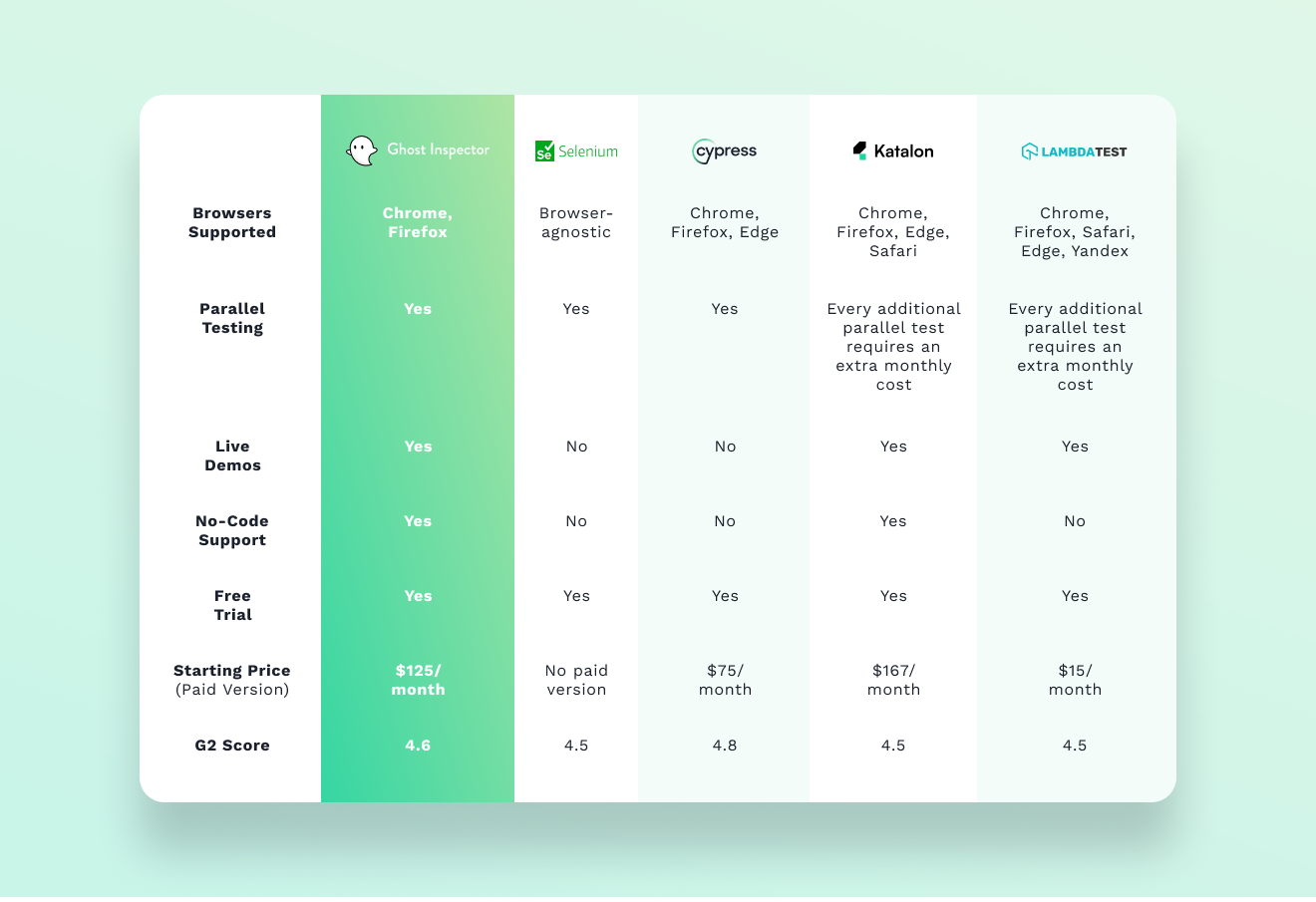
Ghost Inspector is an industry-leading no-code browser testing platform built for teams that want powerful automated testing without writing code. It supports UI testing, visual regression, functional testing, and continuous integration with GitHub, Jenkins, and other CI tools. Tests run on Chrome and Firefox in real-time or automated modes, and parallel test execution is included at no extra cost — a meaningful differentiator from tools that charge more for concurrency.
Cost: Free 14-day trial (no credit card). Paid plans from $109/month.
G2: 4.6/5 — users consistently highlight ease of setup and responsive support.
2. Selenium

Selenium is the most established open-source testing framework in the world — and the foundation many other tools are built on. It supports functional, regression, and cross-browser testing across Java, Python, JavaScript, Ruby, and C#.
Worth noting in 2026: Playwright (see #4) has overtaken Selenium in popularity for new projects due to faster execution and a more modern API. Selenium remains the standard for enterprise teams with existing infrastructure.
Cost: Free and open source.
G2: 4.5/5 — respected but often noted as complex and dated compared to modern alternatives.
3. Cypress
Cypress is a developer-friendly E2E testing framework designed for web apps. It’s popular for its real-time test execution and tight integration into development workflows. Browser support now includes Chrome, Firefox, Edge, and WebKit (Safari). Parallel testing requires the paid Cypress Cloud tier.
Cost: Free open-source version. Cypress Cloud from $75/month.
G2: 4.5/5 — praised for documentation and speed; some complaints about cost at scale.
4. Playwright
Microsoft’s open-source E2E framework has become one of the fastest-growing tools in the space. Playwright communicates directly with browsers (no WebDriver), making tests run up to 42% faster than Selenium equivalents. It covers Chromium, Firefox, and WebKit from a single API — with built-in auto-waiting, parallel execution, API testing, and visual comparison out of the box.
Cost: Free and open source. Cloud service (Microsoft Playwright Testing) from ~$0.06/test minute.
Best for: Engineering-led teams who want a modern, fast, low-flakiness framework without vendor lock-in.
5. BrowserStack
BrowserStack provides cross-browser testing on real devices — over 3,000 browser/device combinations. It integrates with Selenium, Playwright, Cypress, and Appium. Parallel testing is available but increases cost significantly.
Cost: Automation from $129/month. Accessibility testing add-on is $459/month.
G2: 4.5/5 — broad coverage valued; pricing complexity is a common complaint.
6. Katalon

Katalon (or Katalon Studio) is an all-in-one platform for web, API, mobile, and desktop testing. It accommodates both no-code and scripted workflows, making it a good fit for mixed teams. CI/CD integration and parallel execution are supported across plans.
Cost: Free version available. Full platform from $208/month.
G2: 4.5/5 — praised for versatility; occasional performance issues with large test suites noted.
7. Sauce Labs

Sauce Labs is a cloud-based platform for web and mobile testing, built for enterprise teams that need secure, scalable parallel test execution. It supports Selenium, Playwright, Cypress, and Appium.
Cost: Automation from $199/month per concurrent session.
G2: 4.3/5 — reliable but frequently cited as expensive with inconsistent support.
8. LambdaTest
LambdaTest is a rapidly growing cross-browser testing platform and a more affordable alternative to BrowserStack and Sauce Labs. It supports automated, live, and visual testing with integrations for Selenium, Playwright, Cypress, and Appium.
Cost: Free tier available. Paid plans from $15/month.
G2: 4.5/5 — affordability and ease of setup are top positives; real-device depth lags behind BrowserStack.
9. Mabl
Mabl is an AI-powered test automation platform that integrates deeply into CI/CD workflows. Its standout feature is self-healing tests — Mabl’s ML detects UI changes and automatically updates tests to match, reducing maintenance overhead significantly.
Cost: Usage-based, not publicly listed.
G2: 4.4/5 — praised for reducing maintenance time; pricing transparency is a common frustration.
10. TestComplete
TestComplete by SmartBear supports desktop, web, and mobile testing with robust record-and-playback. It’s particularly strong for teams that need to test complex desktop applications — a gap many modern tools leave unfilled.
Cost: From $1,800+/year for the basic desktop plan.
G2: 4.2/5 — flexible but noted for slow execution, occasional instability, and high cost.
11. Perfecto

Perfecto by Perforce is a cloud-based platform for web, mobile, and IoT testing at enterprise scale. Its mobile device lab — covering a large library of real iOS and Android devices — is its primary differentiator.
Cost: From $125/month for automation.
G2: 4.4/5 — device lab quality valued; complex initial setup is a recurring criticism.
12. Testim
Testim uses machine learning to speed up test creation and maintenance for web applications. Update: Testim was acquired by Tricentis in 2022 and now operates within the Tricentis ecosystem, making it a stronger option for teams already using Tricentis Tosca.
Cost: Free trial; paid pricing on request.
G2: Limited reviews — AI-assisted creation is valued; limited integrations and debugging challenges noted.
13. Tricentis Tosca
Tricentis Tosca is a comprehensive enterprise testing suite with a model-based automation approach that minimizes the code testers need to write. In 2026, Tricentis has added generative AI capabilities for test creation and maintenance.
Cost: On request; enterprise pricing.
G2: 4.2/5 — strong for coverage and integrations; limited Mac/Linux support and high cost are drawbacks.
14. QA Wolf

QA Wolf combines an AI-powered platform with human QA engineers to deliver fully managed E2E test coverage. Unlike a pure tool, QA Wolf’s AI maps your app, writes production-grade Playwright and Appium tests, investigates failures, and maintains tests as your product changes. All test code is open and exportable.
Cost: Custom; positioned as a premium managed service.
Best for: Teams that want comprehensive E2E coverage without building a dedicated QA function in-house.
15. Ranorex Studio
Ranorex Studio is a test automation framework for desktop, web, and mobile apps, with particular depth for complex Windows desktop applications and legacy technologies that modern frameworks often can’t handle.
Cost: Approx. $4,650/year (per third-party reports).
G2: 4.2/5 — flexible for complex desktop scenarios; steep learning curve noted.
16. Endtest

Endtest is a codeless test automation platform for web applications, making it one of the most accessible options for non-technical QA teams. It covers functional, regression, and database testing with cross-browser support and parallel execution.
Cost: From $175/month (unlimited executions, one parallel slot).
G2: 4.7/5 — the highest-rated tool on this list; users love the interface, though complex scenarios can hit the limits of codeless editors.
AI in Automated Testing: What to Know in 2026
AI has become a genuine differentiator in test automation. Here’s what’s actually useful:
- Self-healing tests (Mabl, Testim): Automatically update tests when UI changes, reducing maintenance time significantly.
- AI test generation (QA Wolf, Testim): Generate test code from natural language or recorded flows.
- Failure analysis: ML-powered triage that distinguishes real bugs from flaky tests.
- Agentic testing (QA Wolf): AI that autonomously explores your app, identifies coverage gaps, and writes new tests.
When evaluating AI claims, focus on maintenance — that’s where the real time savings are. Tools that only assist with test creation still leave the hard work to you.
Which Tool Is Right for You?
- No coding skills → Ghost Inspector or Endtest
- Developer-led, modern web app → Playwright or Cypress
- Real device cross-browser testing → BrowserStack or LambdaTest
- Complex desktop apps → TestComplete or Ranorex Studio
- AI-managed test maintenance → Mabl or Testim
- Fully managed E2E with AI → QA Wolf
- Enterprise, model-based automation → Tricentis Tosca
- Open-source, broad language support → Selenium or Playwright
Conclusion
The right automation testing tool in 2026 depends on where your team sits on the spectrum from no-code simplicity to full engineering control. AI is raising the bar on what’s possible, and newer tools like Playwright and QA Wolf are setting a high standard for developer experience and managed coverage.
For teams that want easy setup, reliable results, parallel testing at no extra cost, and genuinely great support, Ghost Inspector is hard to beat. Try it free for 14 days — no credit card required.